
an essay on the life and times of Lorenzo the Magnificent
by Snail Archer (2017)
_@v
The life and times of Lorenzo de’ Medici were greatly influenced by Aristotelian philosophy. Lorenzo himself had a mind for magnificence; a virtue around which he based a significant amount of his life. Lorenzo earned himself the contemporary title of il Magnifico, which was in part carried-over from the honorary title of Magnifico Messere he was granted after his father, Piero’s, death in 1469CE, but was, more significantly, tied into the manner with which Lorenzo conducted himself.[1] Although philosophy was an interest of Lorenzo’s, it was the Aristotelian virtue of magnificence from Nicomachean Ethics that truly shaped Lorenzo’s life, being the foundation and salvation of Medicean rule in Florence.
Lorenzo de Medici was subject to the socio-political realities of life in 15th century Florence. With the Renaissance in full-swing, those in power needed to find new ways to legitimise their positions of power, especially if they did not have the traditional foundations of religion or nobility backing them[2]. Renaissance culture was greatly shaped by the ideology of civic humanism. Humanists worked to spread education in classical literature and history, believing strongly that classical antiquity represented a better and brighter time in humanity. They aimed to reform governmental and other social structures into ones modelled on classical ideals. This meant that reproducing Latin-style cultural works gave legitimacy to Medicean rule in Florence. Civic humanism rationalised the political realities of Florence in the 15th century[3]. It was an ideological force which justified the power held by the ordinary men of the Medici, and supported the elitist republic which developed after their rise to power in 1382CE. Furthermore, in the Renaissance, magnificence became one of the greatest virtues. Magnificence was the having of wealth, and the use of that wealth to improve society. Families such as the Medici would utilise their wealth in the funding of great social works, such as the architecture of churches. They would gain social standing by having their family crest attached to such an edifice. Throughout the Italian Peninsula, all ruling authorities were compelled to legitimise their offices through the cultural powers of humanist ideals. Magnificence was the primary manner by which they justified their power and Lorenzo de’ Medici was arguably the most successful of all rulers in achieving this virtue.
Aristotle (384-322BCE) was an ancient Greek philosopher, whose philosophies focused strongly on rationalising the world. As a result of linguistic barriers and the passage of time, Aristotle’s works did not reach most of Europe for some time. The Recovery of Aristotle’s books, a period from the mid-12th century to the late 13th century, saw Aristotle’s books translated from Greek and Arabic into Latin, which opened the door for Aristotelianism in early modern philosophy[4]. Even so, prior to the works of Thomas Aquinas’ Summa Theologica (1265-1274CE), Christianity and Aristotelianism had a poor relationship[5]. Early Greek Christian scholars had difficulty reconciling the teachings, as access to the Corpus Aristotelicum was limited, and a school tradition was needed to fully appreciate Aristotle’s works[6]. The desire of Renaissance humanism to reflect back upon Antiquity and bring forth as much of it as possible, had a extraordinary influence on Italian culture. This influence is evident in the area of philosophy, where previously un-translated works of Aristotle were translated[7]. Leonardo Bruni (1370-1444CE) translated Nicomachean Ethics in his new style of ‘ad sententiam’ to make it available to a wide range of people, and not just those with scholastic training[8]. Bruni judged medieval translations of Aristotle as poor, and encouraged new translations[9]. He devised a fresh conception of Aristotelianism, known as ‘humanistic Aristotelianism’, which stressed political thought, rhetoric and ethics, and aimed to produce good citizens[10]. This is the form of Aristotelianism to which Lorenzo de’ Medici was exposed from his earliest years.
Aristotle’s Nicomachean Ethics expounded upon a wide array of virtues and vices, to be striven for and avoided in turn, in order to make oneself a good person. Of particular relevance to Lorenzo de Medici’s life was the virtue of magnificence. Liberality, or the spending of the right money in the right manner, formed the basis of magnificence[11]. Yet magnificence differed from liberality as it dealt with large sums of wealth[12]. A magnificent man would therefore always be a liberal man. To be magnificent was to be an “artist in expenditure”[13]. One must produce appropriate and great objects or events, and be motivated by nobility of action[14]. A production would be considered great if it provoked the high regard of the spectator[15]. Expenditure in service of religion or public benefaction was always to be considered magnificent[16]. Magnificence can also be shown in private occasions, such as weddings or the welcoming of foreign dignitaries, or in the complimentary exchange of presents[17]. A magnificent man would also equip his house in a manner suitable to his wealth, preferably through expenditure on permanent objects[18]. The vices opposing magnificence were paltriness and vulgarity, which meant the expenditure had been on the wrong objects or in the wrong ways[19]. However, it did not mean overspending on the proper occasions. These steps to achieving magnificence were identical to the way in which Lorenzo lived his life.
The circumstances of Lorenzo’s early life dictated his ability and desire to seek out magnificence. His family had come from a relatively simple background, and had risen rapidly to a position of immense power under the guidance of Cosimo ‘the Elder’ de’ Medici (1389-1464CE). Giovanni di Bicci (1360-1429CE) was a Florentine banker, whose son Cosimo had opened branches of the Medici Bank in all major Italian cities, with agents operating throughout Europe and the Mediterranean. The Medici thus accumulated such a banking empire that it eclipsed older Florentine banking and political families[20]. In 1433CE, the Albizzi family led a charge against Cosimo to have him executed for treason[21]. Cosimo narrowly avoided death, instead being exiled for 10 years. After merely a year, the ruling gonfaloniere invited Cosimo back to Florence due to a lack of funds[22]. Although gonfalonieres continued to be elected, the Medici had from that time become the de facto rulers of Florence. Cosimo’s son, Piero ‘the Gouty’ (1416-1469CE), was not overly fond of the public eye, and after his death, his sons, Lorenzo ‘the Magnificent’ (1449-1492CE) and Giuliano (1453-1478CE), though nominally bankers, became princes and rulers of Florence.
Lorenzo was given the best humanist education available at the time. Tutored by leading scholars from the University of Florence alongside his brother, Giuliano, Lorenzo learned Latin from Gentile Becchi, and Greek and Aristotelian philosophy from Johannes Argyropoulos[23]. Giuliano was not as smart as Lorenzo, but far more handsome, and pleasant but not ambitious, thus he left the ruling to his brother, instead becoming the sweetheart of Florence[24]. Lorenzo was said to have an unquenchable zest for life, being nearly childlike in his enthusiasm for the arts at certain time[25]. Marsilo Ficino was another important tutor in Lorenzo’s life. He tutored Lorenzo on the works of Plato, and encouraged Lorenzo’s love for poetry. Later in his life, Lorenzo’s support for Ficino helped increase the popularity of Plato throughout Florence[26]. Lorenzo had been exposed to the teachings of Aristotle through his humanist education from an early age, and this instilled in him a respect for Aristotle’s philosophies.
The humanist movement reached its peak in Florence during Lorenzo’s life, largely because of the unwavering patronage of the dedicated humanist and poet. Lorenzo had eagerly accepted the role of patron of letters and art in his family, although his patronage is not always clear as his predecessors’[27]. His support of letters is easier to follow than that of art, as he was intimately allied with the writers and scholars of his day[28]. Lorenzo took a special interest in poetry, and swiftly began writing his own poems. He inherited his love of poetry from his mother, Lucrezia, who was a talented poet, from a noble family[29]. Her marriage to Piero, though undoubtedly arranged for political gain, was one of fondness, as demonstrated in letters from her worrying over his health[30]. This had provided a warm home in which Lorenzo could nurture his talents as an artist. Under the prompting of his tutor, Marsilo Ficino, he wrote in his native Tuscan instead of the traditional Latin, following Dante’s example in the Divina Commedia[31]. Lorenzo’s love poetry was styled after Petrarch’s sonnets, but his best poetry is regarded as being that themed on nature[32]. His three poems commonly considered his best are: Ambra, Caccia col Falcone, and Nencia da Barberino, each inspired by the time Lorenzo spent in the Tuscan countryside[33]. Historian J. R. Hale considers Lorenzo’s poetry to be among the best of his time, and the only quality poetry by that of a head of a bank or state[34]. Lorenzo’s patronage of the arts was therefore not only to be a result of the circumstances of the times, but out of his own love for the arts.
Lorenzo was also such a writer that he wrote his own biography, A Commentary on My Sonnets. It has been translated by James Wyatt Cook into English from the original Italian. As with any translation, it will not be a perfect representation of Lorenzo’s intentions, although it is the best version available. It contains a great many reflections upon Lorenzo’s work as a patron and his role in Florentine society. It does not contain a single direct reference to Aristotle’s Nicomachean Ethics, the work which inspired the virtue of magnificence which defined Lorenzo’s life.[35] It contains numerous references to Aristotle and Plato regardless, and the themes of Nicomachean Ethics are present throughout. This indicates the Ethics were likely a mere reality of Lorenzo’s life, rather than that which he actively reflected upon.
Although magnificence was the primary means by which rulers could legitimise their positions through the cultural powers of humanism and the Renaissance, Lorenzo de’ Medici’s magnificence was tempered by his considerable political acumen as well as his own deep love for the arts. Lorenzo’s patronage is not as obvious as his forebears, likely because of straitened financial circumstances he had inherited, yet he still commissioned as many works as his available resources justified[36]. One clear example of Lorenzo’s patronage is how, upon coming into power in 1469CE, he promptly expanded the University of Florence. He was conscious of the fact that Florentine territory had expanded to almost entirely overlap Tuscany[37]. In line with the humanist desire to spread education, Lorenzo was aware the Tuscans needed an educational facility, but that creating a new university would anger the people of Florence, so Lorenzo comprised thusly[38]. Yet this was not Lorenzo’s only act of magnificence, and in fact Lorenzo’s patronage was so extensive it earned him the title of il Magnifico.
Lorenzo ushered in a golden age for Medicean patronage. The Medici palace that Lorenzo had inherited from Cosimo was already filled with many of the greatest artists and minds of the day, and more still were welcomed in by Lorenzo’s enthusiasm. Lorenzo’s court included some of the greatest artists of the Renaissance, including Sandro Botticelli, Michelangelo Buoanarroti, Domenico Ghirlandaio, Andrea del Verrocchio and Leonardo da Vinci[39]. Botticelli painted The Adoration of the Magi (1475CE) as a monument to the Medici family[40]. The painting features the three wise men bearing gifts for the infant Christ, but the crowd holds portraits of Cosimo, Piero, Lorenzo and Giuliano, as well as notable Medici supporters. Lorenzo did his best to secure commissions from Leonardo da Vinci, despite Leonardo’s notorious tendency to lose interest in the work for which he was paid before he could complete it.[41] Lorenzo took special interest in Angelo Poliziano, a poet whom Lorenzo invited to the Palazzo Medici and employed as Lorenzo’s sons’ tutor[42]. Poliziano was a foremost poet of the Laurentian Age, thanks to his use of Tuscan and rejection of Latin-only poetry[43]. Poliziano and Lorenzo became close as a result of this shared love of poetry. Lorenzo met Michelangelo in his garden along the via Larga, and invited the him to stay at the palace[44]. Michelangelo was part of a large, poor family, and without Lorenzo’s patronage he never would have been able to follow his studies[45]. Even when, years later, he forsook the Medici’s as tyrants, he could never bring himself to deny the debt he owed Lorenzo[46]. These close relationships with leading artists of the day enabled Lorenzo to be an excellent patron, excelling in magnificence, despite tight financial circumstances.
Lorenzo’s art collection at the Medici Palace served dual purposes; the first being magnificence in the public eye, but also personal satisfaction with his love for the arts. Since Cosimo, the family had brought visitors to see the collection. Lorenzo’s desire to collect was a family tradition, begun by Giovanni di Bicci, and carried on through Cosimo and Piero[47]. According to the 1492CE inventory of the Medicean collection that followed Lorenzo’s death, his collection of ancient Greek manuscripts was second only to the papal collection[48]. Although Lorenzo was chiefly fascinated in small antiques, he was fond of collecting ancient sculptures which he made accessible to the public by placing them in the San Marco’s garden along the via Larga, which also served to reproduce an atmosphere of Antiquity[49]. This included a number of Roman Imperial busts, such as that of Hadrian, Agrippa and Augustus, with the latter a gift from Pope Sixtus IV in 1471CE for his coronation[50]. In 1471CE, Lorenzo estimated his family had, since 1434CE, spent 663,000 florins on public works[51]. Lorenzo thought the money “well-expended” and that it “cast a brilliant light upon our condition in the city.”[52] In his desire to share the arts with the public of Florence, Lorenzo was second to none in magnificence.
Yet it was not only in the field of patronage that Lorenzo demonstrated his magnificence. In 1464CE, when Cosimo died, Piero became ruler of Florence, and fearing his own poor health, he immediately began training the 15 year old Lorenzo to take over as ruler of Florence. Piero advised his son “do not stint money, but do thyself honour” and “if thou givest dinners or other entertainments do not let there be any stint in money or whatever else is needful to do thyself honour”[53]. This was a direct call to being magnificent. Lorenzo took to his new role like a fish to water. In 1466CE, he convinced Pope Paul II to award the Medici bank the sole control on operating and distributing rights for the papal Tolfa mines which were highly lucrative[54]. This was tremendously significant to the Medici bank, as recent war between Florence and Venice, with Pope Paul II being Venetian, had badly interrupted the course of money into the bank, which they needed to maintain Medicean patronage and thus their political power[55]. Lorenzo learned little about the actual processes of banking throughout his life, but his political acumen was considerable and he turned his attention to diplomacy, poetry, patronage and philosophy to further the Medici Bank’s interests[56]. Lorenzo wrote in his autobiography, “it fares ill in Florence with the rich who do not govern.”[57] Lorenzo was well aware of the political role he needed to play, and the magnificence he needed to do so.
Despite the successes of the Medici under Lorenzo, conspiracy boiled up against the family, and in 1478CE, the Pazzi Conspiracy was carried out to assassinate the family and return Florence to its more republican roots. On Sunday 26, 1478CE, the Pazzi family, supported by King Ferrante of Naples and Pope Sixtus IV in Rome, attempted to assassinate Lorenzo and Giuliano while at church[58]. Giuliano was murdered, and subsequently buried to much public grief, leaving Lorenzo sole master of Florence[59]. Lorenzo, who had miraculously survived, only became more popular in the eyes of the Florentines. He immediately went on the offensive, though in a way unique to Lorenzo that would truly earn him his title of il Magnifico. Lorenzo travelled to Naples to confront King Ferrante. Upon arrival, Lorenzo freed, clothed and paid the galley slaves who had rowed him there, dispensed dowries to poor families so they could make good marriages for their daughters, and set himself up at the local branch of the Medici bank from where he began throwing lavish entertainments for leading families in the city[60]. All of this involved funds the Medici family and bank did not possess. Lorenzo had embezzled an enormous amount of money from the public treasury of Florence, and though most documents on the event were systemically destroyed, one surviving one showed 74,948 florins misappropriated from the Florentine exchequer[61]. Yet, thanks to his displays of magnificence, Lorenzo managed to convince Ferrante and Sixtus IV to sign a peace treaty with Florence[62]. On 13 March, 1480CE, Lorenzo returned to Florence, victorious despite all odds. Lorenzo’s daring voyage to Naples led him to become known throughout Italy as il Magnifico. In the years following, he sent out many Florentine artists as cultural ambassadors to major Italian cities. In 1481CE, he sent Botticelli to Rome to work on the Sistine chapel[63]. Botticelli also painted a celebration of Lorenzo’s success in Naples, featuring Athena taming the Centaur as a metaphor for Lorenzo’s victory over King Ferrante[64]. In defeating the conspirators, Lorenzo had employed magnificence in a creative and daring way, that had ultimately succeeded, and saved the Medici from destruction.
In the aftermath of the Pazzi Conspiracy, though he maintained his popular position in the public eye through magnificence, Lorenzo became more ruthless in his politics. Lorenzo attempted to maintain a civilised, republican, Christian atmosphere in Florence, but understood that there could be no utopia, and so under the surface he acted mercilessly against Florentine and Medicean enemies, going so far as to alter the constitution in 1480CE to reduce the Council of One Hundred, who helped govern Florence, down to the Council of Seventy[65]. Although following this, Lorenzo was, in effect, more the tyrant of Florence than either his forebears had ever been, he was so devoted to humanism that he never resorted to the violence or barbarism of the other tyrants of his times[66]. Despite such political turmoil, Lorenzo kept to his Aristotelian beliefs, and maintained an air of magnificence to legitimise his powers instead of tyranny.
Lorenzo de’ Medici lived a life shaped by magnificence. The circumstances of his times saw it necessary to use cultural powers to legitimise ruling powers, and magnificence was the prime ideal through which this could be achieved. Lorenzo had been exposed to Aristotelian ideals, such as magnificence, throughout his schooling. He absorbed the ideal so fully it permeated throughout his patronage and political works. His extensive support of the many great artists of his day, along with his own contributions to the arts, represented his support for both humanism and Aristotelianism. An in his diplomatic endeavours, Lorenzo applied the principles of magnificence so wonderfully; it earned him the enduring title of il Magnifico.
Appendix One:
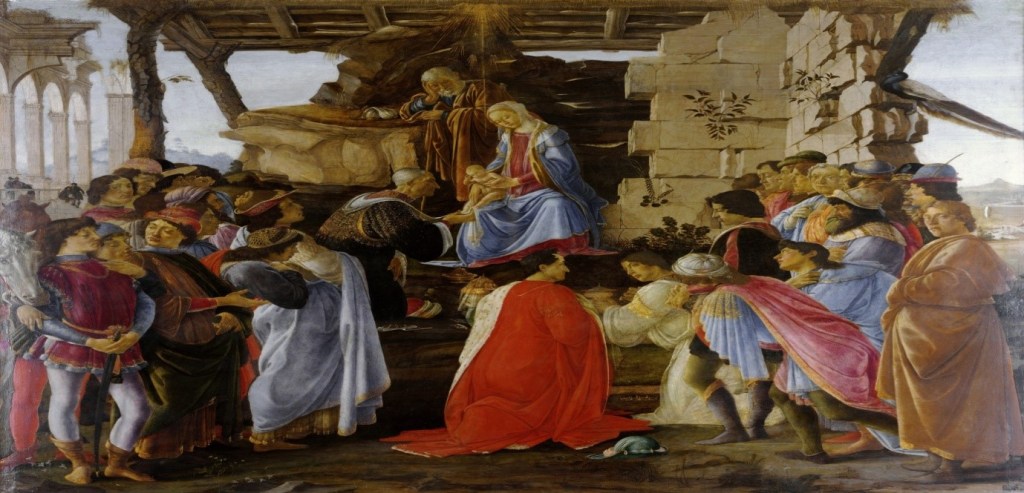
Sandro Botticelli, The Adoration of the Magi (1475)
Available from https://upload.wikimedia.org/wikipedia/commons/9/9d/Botticelli_-_Adoration_of_the_Magi_%28Zanobi_Altar%29_-_Uffizi.jpg
Bibliography
Primary
Aristotle. Nicomachean Ethics. Translated by H. Rackham. Cambridge: Harvard University Press, 1975, p. 207
Botticelli Sandro, The Adoration of the Magi (1475), available from https://upload.wikimedia.org/wikipedia/commons/9/9d/Botticelli_-_Adoration_of_the_Magi_%28Zanobi_Altar%29_-_Uffizi.jpg
Brucker, Gene. The Society of Renaissance Florence: A Documentary Study. New York: Harper & Row, 1971.
de’ Medici, Lorenzo. The Autobiography of Lorenzo de’ Medici The Magnificent: A Commentary on My Sonnets. Translated by James Wyatt Cook. Tempe: Medieval and Renaissance Texts and Studies, 2000.
Lorenzo de’ Medici at Home: The Inventory of the Palazzo Medici in 1492. Translated by Richard Stapleford. Philadelphia: Pennsylvania State University Press, 2013.
Poliziano, Angelo. “Account of the Pazzi Conspiracy. (1478)” In Renaissance Humanism: An Anthology of Sources, edited by Margaret L. King. Indianapolis: Hackett Publishing Company, 2014, pp. 115-120.
Secondary
Brucker, Gene A. Renaissance Florence. New York: Wiley, 1969.
Cleugh, James. The Medici: A Tale of Fifteen Generations. London: Robert Hale & Company, 1975.
Cronin, Vincent. The Florentine Renaissance. London: Collins, 1967.
Elders, Leo J. “The Greek Christian Authors and Aristotle.” In Aristotle in Late Antiquity, edited by Lawrence P. Schrenk. Washington: The Catholic University of America Press, 1994, pp. 111-142.
Hale, J. R. Florence and the Medici; The Pattern of Control. Phoenix: Phoenix Press Paperback, 2004.
Kent, F. W. Lorenzo de Medici and the art of Magnificence, Baltimore: Pennsylvania State University Press, 2004.
Mahoney, Edward P. “Aristotle and Some Late Medieval and Renaissance Philosophies.” In The Impact of Aristotelianism on Modern Philosophy, edited by Riccardo Pozzo. Washington: The Catholic University of America Press, 2004, pp. 1-34.
Perry, Marvin, Myrna Chase, Margaret C. Jacob, and James R. Jacob . Western Civilization: Ideas, Politics, and Society. New York: Cengage, 2008.
Rubinstein, Nicolai. The Government of Florence under the Medici (1434 to 1494). Oxford: Clarendon Press, 1966.
Ruggiero, Guido. The Renaissance in Italy: A Social and Cultural History of the Rinascimento. Cambridge: Cambridge University Press, 2014.
Schevill, Ferdinand. The Medici. New York: Harper & Row, 1949.
Strathern, Paul. Death in Florence: The Medici, Savonarola and the Battle for the Soul of the Renaissance City. London: Jonathan Cape, 2011.
Trexler, Richard C. Public life in Renaissance Florence. New York: Academic Press, 1980.
“Medici Patronage: Magnificence and Splendour.” The State University of New York. http://employees.oneonta.edu/farberas/arth/arth213/Medici_patronage.html
“Why is Lorenzo the Magnificent magnificent?” Medici Dynasty. http://medicidynasty.com/why-is-lorenzo-the-magnificent-magnificent/
[1] “Why is Lorenzo the Magnificent magnificent?”, Medici Dynasty, available from http://medicidynasty.com/why-is-lorenzo-the-magnificent-magnificent/
[2] Vincent Cronin, The Florentine Renaissance (London: Collins, 1967), p. 48.
[3] Guido Ruggiero, The Renaissance in Italy: A Social and Cultural History of the Rinascimento (Cambridge: Cambridge University Press, 2014); Richard C. Trexler, Public life in Renaissance Florence (New York: Academic Press, 1980); Gene A. Brucker, Renaissance Florence (New York: Wiley, 1969).
[4] Marvin Perry, et al., Western Civilization: Ideas, Politics, and Society (New York: Cengage, 2008), p. 261-262.
[5] Leo J. Elders, “The Greek Christian Authors and Aristotle,” in Aristotle in Late Antiquity, ed. Lawrence P. Schrenk (Washington: The Catholic University of America Press, 1994), p. 141-142.
[6] Ibid, p. 141-142.
[7] Edward P. Mahoney, “Aristotle and Some Late Medieval and Renaissance Philosophies,” in The Impact of Aristotelianism on Modern Philosophy, ed. Riccardo Pozzo (Washington: The Catholic University of America Press, 2004), p. 6.
[8] Ibid, p. 7.
[9] Ibid, p. 7.
[10] Ibid, p. 7.
[11] Aristotle, Nicomachean Ethics trans. H. Rackham (Cambridge: Harvard University Press, 1975), p. 207.
[12] Ibid, p. 101.
[13] Ibid, p. 207.
[14] Ibid, p. 207.
[15] Ibid, p. 209.
[16] Ibid, p. 209.
[17] Ibid, p. 211.
[18] Ibid, p. 211.
[19] Ibid, p. 205.
[20] Paul Strathern, Death in Florence: The Medici, Savonarola and the Battle for the Soul of the Renaissance City (London: Jonathan Cape, 2011), p. 11.
[21] Ibid, p. 11.
[22] Ibid, p. 11.
[23] Paul Strathern, Death in Florence: The Medici, Savonarola and the Battle for the Soul of the Renaissance City (London: Jonathan Cape, 2011), p. 13; James Cleugh, The Medici: A Tale of Fifteen Generations (London: Robert Hale & Company, 1975), p. 115.
[24] James Cleugh, The Medici: A Tale of Fifteen Generations (London: Robert Hale & Company, 1975), p. 115.
[25] Ferdinand Schevill, The Medici (New York: Harper & Row, 1949), p. 166.
[26] Ibid, p. 155-156.
[27] Ibid, p. 163.
[28] Ibid, p. 163.
[29] J. R. Hale, Florence and the Medici; The Pattern of Control (Phoenix: Phoenix Press Paperback, 2004), p. 49; Ferdinand Schevill, The Medici (New York: Harper & Row, 1949), p. 163.
[30] Paul Strathern, Death in Florence: The Medici, Savonarola and the Battle for the Soul of the Renaissance City (London: Jonathan Cape, 2011), p. 12.
[31] Ferdinand Schevill, The Medici (New York: Harper & Row, 1949), p. 153; James Cleugh, The Medici: A Tale of Fifteen Generations (London: Robert Hale & Company, 1975), p. 115; Paul Strathern, Death in Florence: The Medici, Savonarola and the Battle for the Soul of the Renaissance City (London: Jonathan Cape, 2011), p. 14.
[32] Ferdinand Schevill, The Medici (New York: Harper & Row, 1949), p. 161.
[33] J. R. Hale, Florence and the Medici; The Pattern of Control (Phoenix: Phoenix Press Paperback, 2004), p. 53; Ferdinand Schevill, The Medici (New York: Harper & Row, 1949), p. 161.
[34] J. R. Hale, Florence and the Medici; The Pattern of Control (Phoenix: Phoenix Press Paperback, 2004), p. 53
[35] Lorenzo de’ Medici. The Autobiography of Lorenzo de’ Medici The Magnificent: A Commentary on My Sonnets, trans. James Wyatt Cook (Tempe: Medieval and Renaissance Texts and Studies, 2000).
[36] Ferdinand Schevill, The Medici (New York: Harper & Row, 1949), p. 163-164.
[37] Ibid, p. 154-155.
[38] Ibid, p. 154-155.
[39] James Cleugh, The Medici: A Tale of Fifteen Generations (London: Robert Hale & Company, 1975), p. 110.
[40] Appendix One; Paul Strathern, Death in Florence: The Medici, Savonarola and the Battle for the Soul of the Renaissance City (London: Jonathan Cape, 2011), p. 30.
[41] Ibid, p. 30.
[42] Ibid, p. 30.
[43] Ferdinand Schevill, The Medici (New York: Harper & Row, 1949), p. 160.
[44] Ibid, p. 163.
[45] Ibid, p. 163.
[46] Ibid, p. 163.
[47] F. W. Kent, Lorenzo de Medici and the art of Magnificence, (Baltimore: Pennsylvania State University Press, 2004), p. 131.
[48] Lorenzo de’ Medici at Home: The Inventory of the Palazzo Medici in 1492, trans. Richard Stapleford (Philadelphia: Pennsylvania State University Press, 2013).
[49] Ferdinand Schevill, The Medici (New York: Harper & Row, 1949), p. 163.
[50] Lorenzo de’ Medici at Home: The Inventory of the Palazzo Medici in 1492, trans. Richard Stapleford (Philadelphia: Pennsylvania State University Press, 2013).
[51] Gene Brucker, The Society of Renaissance Florence: A Documentary Study (New York: Harper & Row, 1971), p. 27.
[52] “Medici Patronage: Magnificence and Splendour,” The State University of New York, available from http://employees.oneonta.edu/farberas/arth/arth213/Medici_patronage.html; Gene Brucker, The Society of Renaissance Florence: A Documentary Study (New York: Harper & Row, 1971), p. 27
[53] Paul Strathern, Death in Florence: The Medici, Savonarola and the Battle for the Soul of the Renaissance City (London: Jonathan Cape, 2011), p. 15.
[54] Paul Strathern, Death in Florence: The Medici, Savonarola and the Battle for the Soul of the Renaissance City (London: Jonathan Cape, 2011), p. 15-16; James Cleugh, The Medici: A Tale of Fifteen Generations (London: Robert Hale & Company, 1975), p. 101.
[55] Paul Strathern, Death in Florence: The Medici, Savonarola and the Battle for the Soul of the Renaissance City (London: Jonathan Cape, 2011), p. 15-16; James Cleugh, The Medici: A Tale of Fifteen Generations (London: Robert Hale & Company, 1975), p. 101.
[56] Paul Strathern, Death in Florence: The Medici, Savonarola and the Battle for the Soul of the Renaissance City (London: Jonathan Cape, 2011), p. 18.
[57] James Cleugh, The Medici: A Tale of Fifteen Generations (London: Robert Hale & Company, 1975), p. 115.
[58] Paul Strathern, Death in Florence: The Medici, Savonarola and the Battle for the Soul of the Renaissance City (London: Jonathan Cape, 2011), p. 33-36.
[59] Angelo Poliziano, “Account of the Pazzi Conspiracy (1478)” in Renaissance Humanism: An Anthology of Sources, ed, Margaret L. King (Indianapolis: Hackett Publishing Company, 2014), p. 117.
[60] Ibid, p. 33-36.
[61] Ibid, p. 33-36.
[62] Ibid, p. 33-36.
[63] Ibid, p. 37.
[64] Ferdinand Schevill, The Medici (New York: Harper & Row, 1949), p. 164-165.
[65] Nicolai Rubinstein, The Government of Florence under the Medici (1434 to 1494) (Oxford: Clarendon Press, 1966), p. 201; Paul Strathern, Death in Florence: The Medici, Savonarola and the Battle for the Soul of the Renaissance City (London: Jonathan Cape, 2011), p. 36; James Cleugh, The Medici: A Tale of Fifteen Generations (London: Robert Hale & Company, 1975), p. 119-120.
[66] Ferdinand Schevill, The Medici (New York: Harper & Row, 1949), p. 166.

 Archer's Library

Leave a comment