
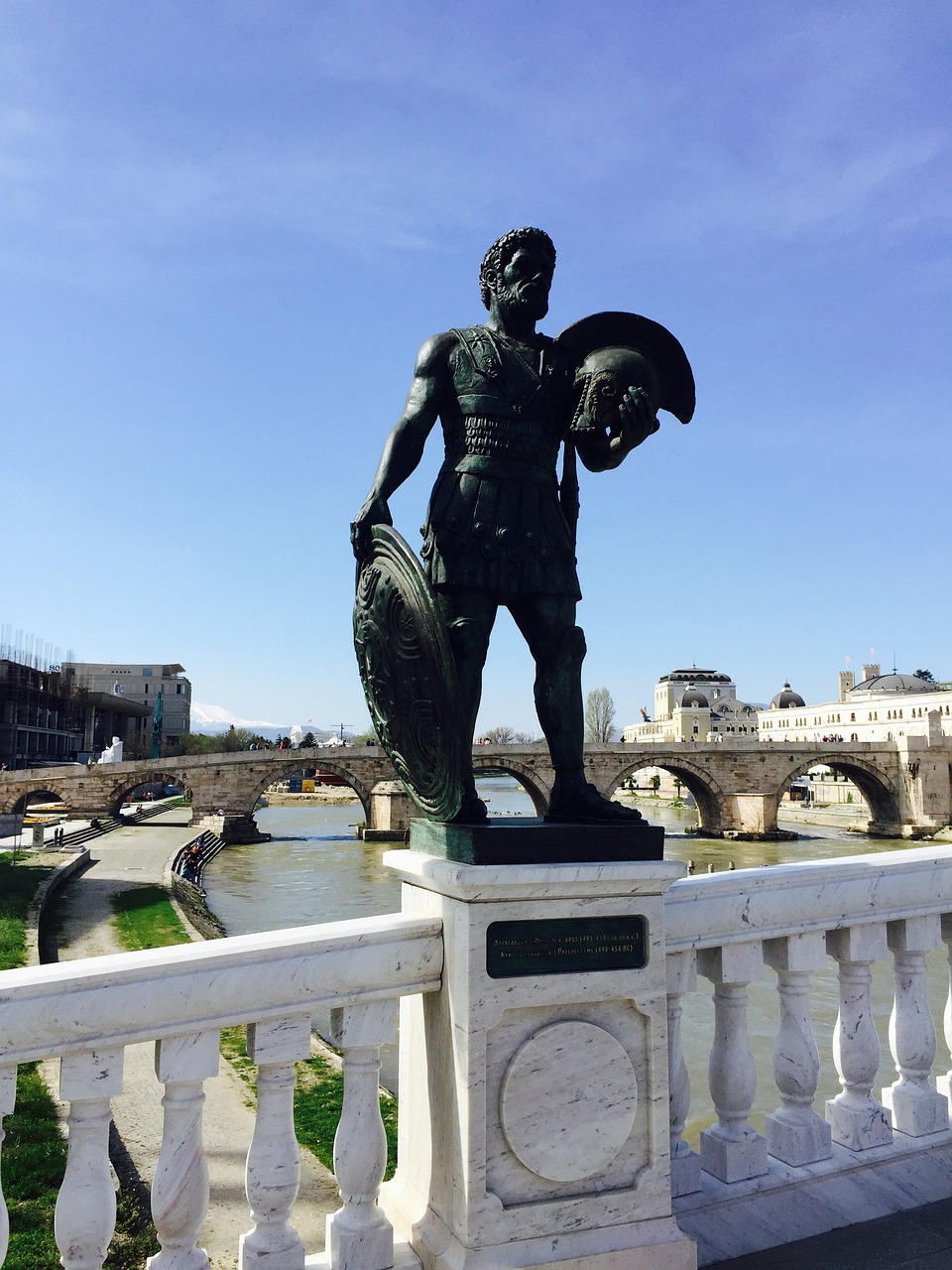
A/N: An oldie but a goodie, this essay explains in short how King Phillip II of Macedon, famously the father of Alexander the Great, conquered Greece. This was a watershed event in history which not only united the Greek city-states under a single banner but would lead to Alexander being able to create one of the greatest empires of history.
Snail Archer (2014)
_@v
The extension of Macedonian control over Greece by 338BCE was due to King Phillip II, the warrior-diplomat who united Macedonia, revolutionised its army, captured a significant amount of the Balkan states and took advantage of Greek affairs so he could control Greece after the decisive Battle of Chaeronea in 338BCE. Demosthenes described Phillip II as “…an unscrupulous and clever opportunist”, “…a liar and deceiver.” and Phillip II did often and succesfully use others to his advantage. Through the use of a decisive intellect, Phillip II managed to subdue Greece after many years of diplomatic and military efforts, all for his desire for glory which was not control of Greece, but of Persia.
Phillip II’s accession in 359BCE was to a divided and weakened Macedonia, and his keen intellect and diplomatic skills were required to secure him the break in hostilities needed to rebuild his army. He agreed to pay tribute to the Illyrians, who were now occupying the Upper Cantons, and to the Paeonians who had begun raiding the Macedonian lowlands. There is a lack of information on Phillip II’s meeting with Bardylis, the Illyrian leader, however Gabriel suggests Phillip II agreed to formalise their occupation of the Upper Cantons as well as pay tribute. He also attempted to appease Athens by withdrawing the Macedonian garrison from the much-disputed Amphipolis but this only incensed Athens who took the withdrawal as a sign of weakness. However, Phillip II’s new army – which consisted of heavy-and-light infantry, cavalry and corps of siege troops, and was later rigorously trained to operate all-year which gave him a seasonal advantage over the Greeks, as described by contemporary Athenian orator Demosthenes “Summer and winter are alike to him [Phillip]… he has no particular season for rest”, and as modern historian Gary Kenworthy details was equipped with the xyston, a 9-10 foot lance for cavalry, and sarissa, a 5.5m pike that had a striking-range advantage over the Greek hoplite’s 2-3m spear that was critical to the success of Phillip II’s infantry – was anything but weak; as he proved when he forced the Paeonians and Illyrians from Macedonia at the first opportunity despite his recent treatises with them, and established the first firm control a Macedonian king had ever had over the Upper Cantons. Finally he married Olympias of Epirus in a diplomatic gesture to stabilize the western frontier. It was decisive military actions and diplomatic overtures like these that Phillip II specialised in, and what would allow him to extend Macedonian control over Greece by 338BCE.
After achieving a national stability for Macedonia, Phillip II turned his gaze outwards, first to the much-disputed Amphipolis in the Thermaic Gulf, which blocked his expansion east. After diplomacy failed, in 357BCE Phillip II laid siege to Amphipolis and took it. With the city under Macedonian control, Phillip II allied himself with the Chalcidian League by capturing Athenian-controlled Potidaea for them and so was able to extend control into Thrace. He captured the Thracian city of Crenides and renamed it Phillippi in 356BCE, giving him access to the nearby gold and silver mines at Mount Pangaeum that would allow him to finance his army, whilst unscrupulously buying off Greek politicians and paying for plentiful mercenary assistance in his later expansion efforts. Phillip II campaigned in Thrace for a year in 352BCE, throughout winter as his army was uniquely capable, winning him significant territory. In order to erase Athenian influence from his territory, he turned on the Chalcidian League much as he had Illyria and Paeonia in the past, and defeated Olynthos and the other thirty-one poleis of Chalcidice, thereby removing all remaining threats from northern Greece and he achieved this through the use of his superior military tactics. Having extended Macedonian control over northern Greece, Phillip II turned southward, his desire for expansion and glory driving him to take control of Greece, whose Athenian naval fleet would allow him to fight Persia.
In order to continue to extend Macedonian control over Greece, Phillip II had to first control Thessaly, the gateway between Macedonia and Greece, and then weaken the Greek poleis through diplomatic devices, sabotage and alliances. In 358BCE, the head of the Thessalian League requested Phillip II intervene with the tyrants of Pherae, the opposing force to the Thessalian League within Thessaly. This placed Phillip II in a position of political power within a Greek state and would allow him through diplomatic manipulation of Thessaly and minor military action on their behalf to extend Macedonian control over Thessaly. In 355BCE, when the Sacred War began, Phillip II was fully drawn into Greek affairs, and he attacked Pherae which sided with Phokis on behalf of the Thessalian League which had sided with the Amphictyonic League who had declared war on Phokis for allegedly defiling the Delphi sanctuary by farming land near the shrine. Diodorus Siculus suggests this occurred while Phillip II was laying siege to Methone, demonstrating the importance with which Phillip II viewed his relationship with Thessaly. As a result, Phillip II was voted by free election to be the archon of the Thessalian League, making him commander of their military forces and controller of their taxes, therefore Thessaly was under Macedonian control and would remain so for the next 150 years. Phillip could have easily forced the poorly defended pass at Thermopylae and ended the Sacred War, but as Demosthenes stated, Phillip II was an opportunist, and so he watched the other Greek states weaken themselves until in 346BCE, when he initiated the Peace of Philocrates, an excellent use of political devices on Phillip II’s behalf because although it was met by the unfavourable reactions of Demosthenes and his loyal Athenians as detailed by Roberts, the Peace was seen as a fantastic thing by the majority of Greece. Phillip had thus weakened Greece while simultaneously tricking most poleis into trusting him and thus set himself up to fully extend Macedonian control over Greece by 338BCE.
Athenian reaction to Phillip II, led by Demosthenes, was the leading opposition to the extension of Macedonian control over Greece, as Estenson describes. In 341BCE, Athens provided Callias of Chalcis with ships that he used to attack Macedonian cities and then in 340BCE Athens sent Diopeithes to the Chersonese to oppose Phillip II’s efforts in Thrace. Both breached the terms of the Peace of Philocrates, yet Phillip II did not declare war on Athens. He needed their cooperation for his intended campaign on Persia. This is another instance of Phillip II employing political sabotage and diplomacy before military action which was a key part of his strategy, not attempted before by any Greek ruler. The encyclopaedia Britannica details Phillip II came to Phokis due to the Fourth Sacred War and ordered the city repopulated and restored. This diplomatic move allowed him the use of Phokis as a base, so Phillip II set out against Athens in 339BCE, but details of these events are not known. Phillip II made to pass through Boetia and force Theban neutrality but Demosthenes convinced them to fight against Macedonia. This alliance of Athens and Thebes lead to the Battle of Chaeronea in 338BCE, which Phillip II won with the advantage of his excellent cavalry. Despite his victory, Phillip II reached for peace with Athens, still seeking to have them switch to his side. Athens had little choice but to accept, and soon after the Boetian League was dissolved and a Macedonian garrison placed in Thebes and Corinth. Though Sparta firmly refused Macedonian hegemony from its place in the Peloponnese, the other poleis which had controlled Greece in hegemonies over the fourth century BCE – Athens and Thebes – were firmly under Macedonian control. Phillip II had successfully extended Macedonian control over Greece by 338BCE via his excellent use of military tactics and the creation of fifth columns, opening up the opportunity of campaigning in Persia Phillip II had always desired.
Phillip II was key to the extension of Macedonian control over Greece by 338BCE, as the warrior-diplomat who revolutionised the Macedonian army and stabilised Macedonia, and used diplomacy before military action to seize the Balkan States and finally Greece, when he defeated the joint armies of Athens and Thebes by the use of the Macedonian cavalry at the Battle of Chaeronea in 338BCE. Macedonia therefore had absolute hegemony over Greece, allowing Phillip II to set up the campaign in Persia that he had desired.
BIBLIOGRAPHY
- Estenson, M, (1994), Understanding Ancient Worlds, Australia, Science Press
- Encyclopaedia Britannia, (2014), Philip II, http://www.britannica.com/EBchecked/topic/456053/Philip-II/Last-years, 10.06.2014
- Gabriel, R, (2010), Philip II of Macedonia: Greater than Alexander, Washington, Potomac Books.
- Hennessy, D, (1991), Studies in Ancient Greece, The United Kingdom, Nelson Thornes
- History of Macedonia, (2013), Philip of Macedon, http://www.historyofmacedonia.org/AncientMacedonia/PhilipofMacedon.html, 10.06.2014
- Koutsouki, A. J., (1989) Ancient Greece (History of the Ancient World), England, Longman Publishing Group
- Lendering, J, Phillip II of Macedon, http://www.livius.org/phi-php/philip/philip_ii.htm#Rise, 10.06. 2014
- Mee, C, Spawforth, A, (2001), Greece, New York, Oxford University Press
- Oxford University Press, A Brief History of Ancient Greece Politics, Society, and Culture, http://global.oup.com/us/companion.websites/9780195372359/student/chapter10/, 10.06. 2014
- Roberts, P, (2006), Excel HSC – Ancient History Book 2 Study Guide, Australia, Pascal Press
- Worthington, I, (2014), By the Spear: Philip II, Alexander the Great, and the Rise and Fall of the Macedonian Empire (Ancient Warfare and Civilization), the United Kingdom, Oxford University Press
- Worthington, I, (2010), Philip II of Macedonia, USA, Yale University Press

 Archer's Library
Leave a comment